The Future of Healthcare: How XR and VR Are Transforming Patient Care and Medical Training
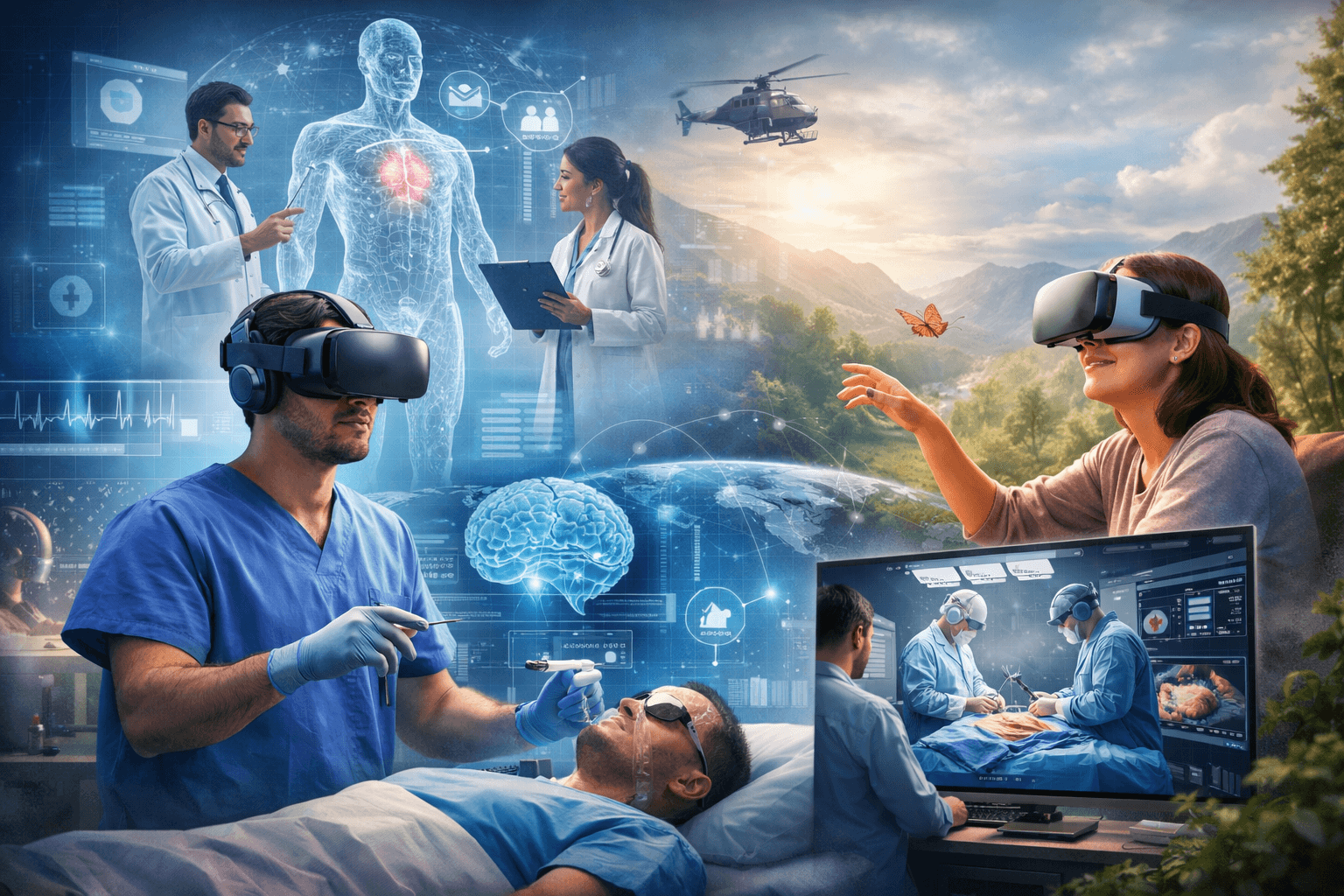
The Future of Healthcare: How XR and VR Are Transforming Patient Care and Medical Training
Healthcare is undergoing a quiet but powerful transformation—and at the center of it is immersive technology. Extended Reality (XR), which includes Virtual Reality (VR), Augmented Reality (AR), and Mixed Reality (MR), is rapidly reshaping how medical professionals learn, diagnose, and treat patients.
What once felt like science fiction is now becoming a practical, scalable solution to some of healthcare’s biggest challenges.
What is XR in Healthcare?
XR refers to immersive technologies that blend the physical and digital worlds. In healthcare, this means creating simulated environments where medical professionals can interact with realistic scenarios without real-world risks.
- VR (Virtual Reality): Fully immersive digital environments
- AR (Augmented Reality): Digital elements overlaid onto the real world
- MR (Mixed Reality): Interactive blending of real and virtual environments
These technologies are not just innovative—they are redefining how healthcare systems operate.
Revolutionizing Medical Training
Traditional medical training relies heavily on textbooks, lectures, and limited real-world exposure. XR changes that by offering hands-on, repeatable, and risk-free simulations.
With VR-based simulations:
- Medical students can practice complex procedures multiple times
- Mistakes become learning opportunities without harming patients
- Rare or critical scenarios can be recreated on demand
For example, a trainee can step into a virtual emergency room and manage a high-pressure situation, improving both technical skills and decision-making under stress.
This leads to better-prepared clinicians and ultimately safer patient outcomes.
Reducing Medical Errors
Medical errors remain a significant issue globally, often due to lack of experience or high-stress environments. XR directly addresses this by improving clinical preparedness and confidence.
Through immersive simulations:
- Clinicians develop muscle memory for procedures
- Teams can practice communication and coordination
- Decision-making improves in time-sensitive situations
The result is a measurable reduction in errors, which benefits both patients and healthcare systems financially and ethically.
Enhancing Patient Care
XR is not just for training—it is also improving patient care in meaningful ways.
Pain Management
VR has been used to distract patients during painful procedures or recovery. Immersive environments can reduce perceived pain and anxiety without additional medication.
Mental Health Therapy
VR is being used in exposure therapy to treat conditions like PTSD, anxiety, and phobias by safely simulating triggering environments.
Rehabilitation
Patients recovering from injuries or surgeries can engage in interactive VR exercises that make therapy more engaging and effective.
Bridging Accessibility Gaps
One of the most promising aspects of XR is its ability to scale healthcare training and access globally.
- Remote regions can access high-quality medical training
- Institutions can reduce costs associated with physical simulation labs
- Healthcare professionals can train anytime, anywhere
This democratization of medical education could significantly reduce disparities in healthcare quality worldwide.
Challenges and Considerations
Despite its potential, XR in healthcare is not without challenges:
- Hardware limitations: VR equipment can still be expensive
- Performance and realism: Simulations must be highly accurate
- Adoption barriers: Training institutions may resist change
- Technical complexity: Multi-platform systems require robust QA and testing
Ensuring reliability, stability, and realism is critical—this is where strong quality assurance processes become essential.
The Role of QA in XR Healthcare Systems
As XR platforms grow more complex—spanning web, desktop, VR devices, and cloud streaming—ensuring quality becomes increasingly challenging.
QA teams play a vital role in:
- Testing immersive interactions and user flows
- Validating performance across devices
- Identifying edge cases in complex simulations
- Ensuring a seamless and bug-free user experience
In healthcare, there is zero tolerance for failure. Even minor issues can impact training effectiveness or patient outcomes.
Looking Ahead
XR is still evolving, but its trajectory is clear: it will become a foundational component of modern healthcare systems.
As technology advances, we can expect:
- More realistic and AI-driven simulations
- Wider adoption across hospitals and universities
- Integration with real-time patient data
- Greater personalization in training and treatment
The intersection of XR and healthcare is not just about innovation—it’s about saving lives, improving outcomes, and building a more efficient and accessible healthcare system.
Final Thoughts
XR and VR are no longer experimental technologies—they are practical tools with real-world impact. From training the next generation of clinicians to enhancing patient care, immersive technology is shaping the future of healthcare in profound ways.
For those entering the tech field—especially in QA, development, or product design—this space offers an exciting opportunity to work on meaningful, high-impact solutions.
The future of healthcare isn’t just digital—it’s immersive.
Have a project in mind?
I'm currently available for freelance projects and technical consulting.
Get in Touch