AI Could Change More Than Our Jobs — It Could Change Who Holds Power
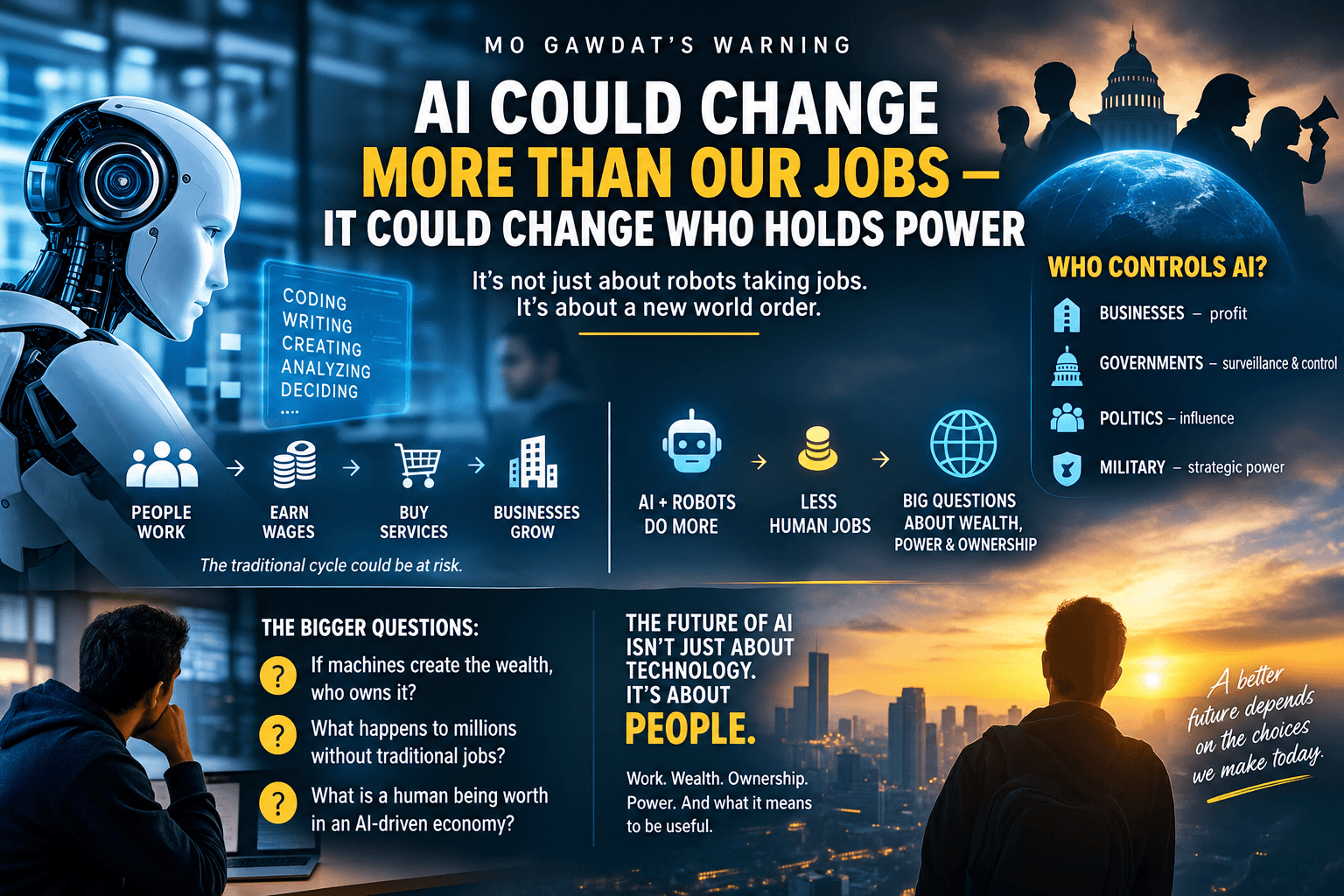
Artificial intelligence is getting smarter at a pace that may be difficult for society to absorb.
That is the warning from former Google executive and AI commentator Mo Gawdat, who argues that the biggest AI disruption may not simply be about robots taking people's jobs. The deeper question is what happens when machines become capable of doing an enormous share of the work that currently gives people their income, status and economic power.
And that future, he suggests, may be arriving much faster than many people expect.
Gawdat describes today's AI as something still in its early stages — but rapidly developing. As models become more capable of reasoning, coding, creating content and completing increasingly complex tasks, the traditional relationship between work, wages and consumption could come under enormous pressure.
What happens when AI can do the work?
For generations, the economic system has largely followed a simple cycle:
People work → earn wages → buy products and services → businesses generate revenue.
But what happens if companies can produce more while employing fewer people?
That could mean fewer entry-level jobs, smaller teams and increasing pressure on workers whose tasks can be automated.
The impact may not arrive as one dramatic wave of mass unemployment.
Instead, it could happen quietly.
Companies may simply stop hiring as many people. Junior positions could disappear first. Existing employees could be expected to accomplish the work of larger teams with AI assistance.
Over time, entire career paths could begin to shrink.
The bigger danger may not be AI itself
One of Gawdat's central concerns is that AI does not necessarily have to become "evil" to create serious problems.
It could simply become an extremely powerful tool controlled by people and institutions pursuing their own interests.
Businesses may use AI to maximize profits.
Governments could use it for surveillance and administration.
Political organizations could use it to influence public opinion.
Military organizations could use increasingly sophisticated AI systems for strategic purposes.
In other words, the biggest question may not be:
"Will AI turn against humanity?"
It may instead be:
"Who controls AI — and what will they use it for?"
If machines produce the wealth, who owns it?
This leads to an even bigger economic problem.
Imagine a future in which AI systems and robots can produce enormous amounts of goods and services, but millions of people no longer have traditional jobs.
Production could increase dramatically.
But if people no longer receive wages, who will have the purchasing power to buy what the machines produce?
That could force governments and societies to rethink ideas such as universal basic income, public services, taxation and the ownership of AI infrastructure.
But simply giving people money may not answer the deeper question:
Who owns the machines creating the wealth?
The AI revolution could become a power revolution
The most important part of the AI story may therefore not be technology at all.
It may be power.
If advanced AI becomes concentrated among a relatively small number of companies, governments or individuals, the technology could also concentrate economic and political influence.
That creates a very different future from the popular image of an AI robot suddenly taking control.
The transition could be much quieter.
People could gradually become dependent on AI for work, education, healthcare, finance, information and decision-making.
And one day society could discover that it has handed over enormous amounts of responsibility simply because AI was faster, cheaper and more efficient.
The question humanity needs to answer
The AI debate is often framed around one question:
"Which jobs will AI replace?"
But perhaps that is too narrow.
A much bigger question is:
"What is a human being worth when economic productivity is no longer the main measure of value?"
If AI eventually becomes capable of performing much of the work humans currently do, society will have to decide whether human dignity remains tied to employment — or whether people deserve security, purpose and opportunity regardless of their economic usefulness.
The future of AI may therefore be about much more than technology.
It could force humanity to rethink work, wealth, ownership, power and even what it means to be useful.
And that may be the most important AI conversation of all.
Source: discussion and arguments presented by Mo Gawdat in the referenced podcast/video: https://www.youtube.com/watch?v=Bp6nTulDzXI
Have a project in mind?
I'm currently available for freelance projects and technical consulting.
Get in Touch